Healthcare systems are complex. Between patient intake, documentation, medical coding, imaging, scheduling, and discharge planning, clinicians and administrators spend countless hours on repetitive tasks that don’t directly improve patient outcomes.
What if some of that workload could be automated — not replaced, but amplified with intelligence and reliability?
That’s where AI clinical workflow automation becomes a strategic advantage.
AI-powered automation is not futuristic — it’s happening now. And it’s reshaping how healthcare providers work, how patients experience care, and how systems manage operational complexity.
Why Manual Clinical Workflows Are a Bottleneck
Clinical workflows involve a series of interconnected tasks. In most care environments, many of these tasks are manual:
- Maintaining patient records
- Coding diagnoses and procedures
- Aligning clinical notes with billing requirements
- Coordinating cross-departmental communication
- Scheduling follow-ups and prescription renewals
These tasks consume precious time and increase the risk of human error. Studies have repeatedly shown that inefficient processes contribute to clinician burnout, lower patient satisfaction scores, and administrative overhead that diverts resources from direct care.
Healthcare deserves better.
What AI Clinical Workflow Automation Actually Does
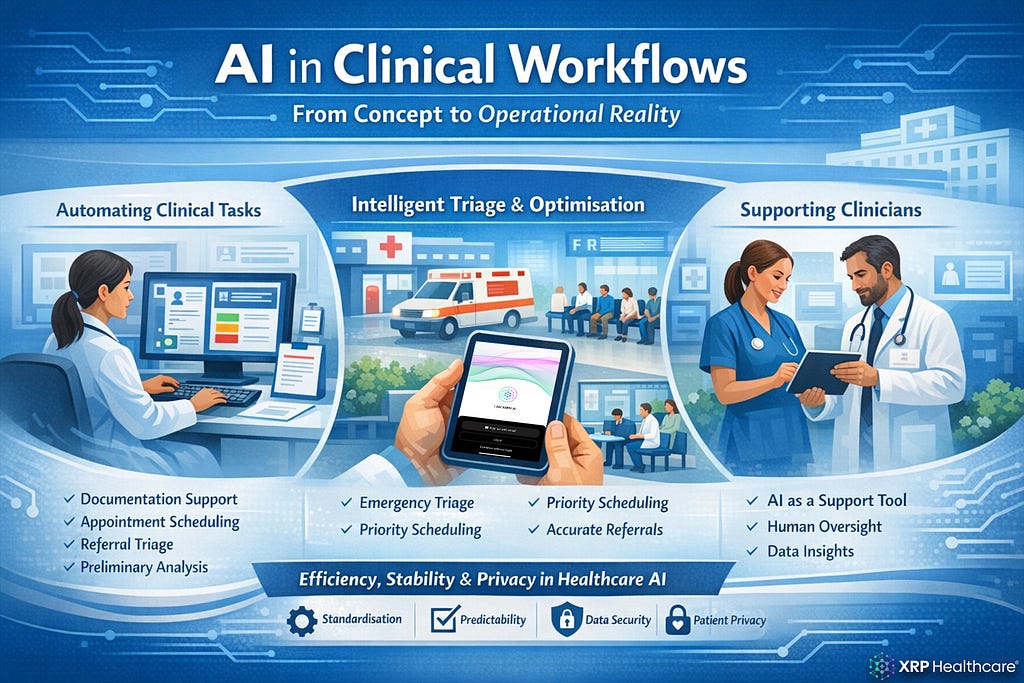
AI clinical workflow automation uses machine learning and natural language processing to assist with tasks that historically required human intervention. Importantly, this is not about replacing clinicians — it’s about augmenting capability and eliminating repetitive load so caregivers can focus on care, not clerical work.
Examples include:
- Automated Documentation: AI transcribes and structures clinical notes from voice or text input, reducing administrative burden.
- Intelligent Coding Support: Algorithms help match clinical documentation to accurate billing codes, improving compliance and reducing denials.
- Workflow Orchestration: AI streamlines handoffs between departments, ensuring that nothing gets delayed in the care continuum.
- Predictive Alerts: Systems can prioritize tasks based on patient risk or urgency, reducing oversight gaps.
These applications accelerate workflow without diminishing quality or safety.
The Patient Experience Improves When Workflows Improve
Faster processes translate into more time with clinicians. When documentation, scheduling, and coordination are frictionless:
- Patients spend less time waiting
- Clinicians can focus on clinical judgment and empathy
- Administrative errors decline
- Care delivery becomes more consistent and predictable
In essence — better workflows catalyze better care.
Why Governance and Oversight Matter
As we adopt AI into core clinical processes, governance is essential. Automation without oversight can magnify errors, bias, and inattentive decision logic.
Responsible AI clinical workflow automation must:
- Be transparent and auditable
- Operate with clear clinical oversight
- Be aligned with regulatory compliance
- Maintain patient safety as the highest priority
At XRP Healthcare, our approach to AI is not about novelty — it’s about responsible execution. AI is a tool. Trust is the infrastructure.
AI Is Already Reshaping Healthcare Operations — Are You Ready?
Healthcare productivity is no longer a siloed goal — it’s a system-wide imperative. As pressure mounts on providers to improve quality at scale, AI clinical workflow automation is proving to be one of the most practical levers available today.
This shift isn’t incremental — it’s transformational.
And it’s happening now.
To learn more about how XRP Healthcare is integrating responsible AI into real healthcare systems, visit www.xrphealthcare.ai.
#Clinical #Workflow #Automation #Transforming #Healthcares #Operational #Backbone
About the Author