Global payments still operate on infrastructure built decades ago.
Cross-border transfers take days to settle. Liquidity is locked in pre-funded correspondent accounts. Fees accumulate across multiple intermediaries. Transparency is limited. Reconciliation is slow.
For high-growth markets and internationally operating businesses, these inefficiencies are structural constraints on capital movement.
Blockchain technology is addressing this problem at the infrastructure level.
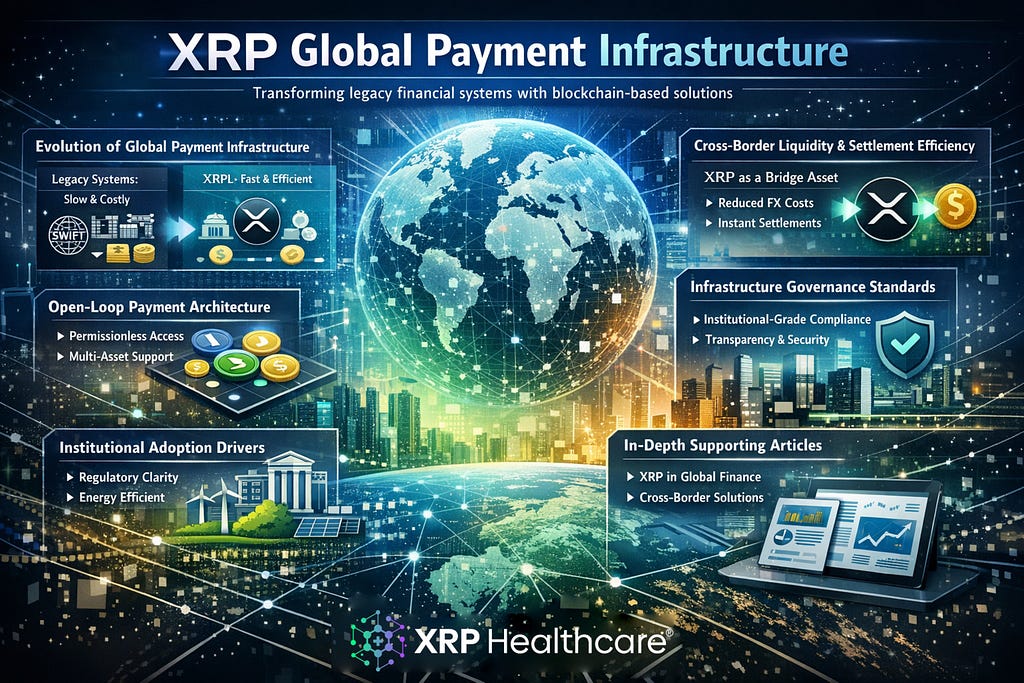
The XRP Ledger (XRPL) was designed for high-throughput, low-cost, real-time settlement. It provides decentralized payment rails capable of moving value across borders within seconds — without the friction embedded in legacy banking systems.
This is infrastructure.
Why Traditional Cross-Border Payments Are Inefficient
Most international transfers rely on correspondent banking networks. Banks maintain nostro and vostro accounts across jurisdictions, pre-funding liquidity to facilitate foreign exchange settlement.
Each intermediary introduces:
- Additional fees
- Processing delays
- Counterparty exposure
- Reconciliation complexity
Settlement can take two to five business days depending on corridor and compliance checks.
For enterprises operating across Africa, the Middle East, Asia, Europe, and North America, delayed settlement directly impacts working capital cycles and operational velocity.
In global commerce, capital efficiency matters.
How the XRP Ledger Enables Real-Time Global Settlement
The XRP Ledger uses a consensus mechanism that allows transactions to finalize within seconds. Unlike proof-of-work blockchains, XRPL does not rely on mining. It achieves deterministic finality with minimal transaction costs and high scalability.
Core characteristics include:
- Near-instant settlement
- Low and predictable transaction fees
- High throughput capacity
- Bridge liquidity using XRP
- Decentralized validator participation
This architecture enables liquidity to be sourced on demand rather than locked into pre-funded foreign accounts.
Value moves faster. Costs become predictable. Settlement becomes programmable.
Open Financial Infrastructure vs Closed Banking Systems
Legacy financial systems operate in closed loops. Access is limited. Innovation is slow. Integration is complex.
XRPL operates as open financial infrastructure.
Institutions, fintech platforms, and enterprises can build on top of a shared settlement layer while maintaining operational independence. This reduces reliance on centralized intermediaries and allows new cross-border corridors to develop — particularly in emerging markets where traditional banking infrastructure may be fragmented.
Open settlement rails create flexibility.
Flexibility drives scalability.
Governance and Legal Structure
XRP Healthcare LLC operates all XRPH token, wallet, and blockchain activities as a standalone legal entity. XRP Healthcare M&A Holding Inc. has no involvement in the XRPH token, digital assets, or wallet operations. For regulated healthcare M&A and AI activities, visit www.xrphealthcare.ai.
Why Blockchain Payment Infrastructure Matters for Emerging Markets
Emerging markets often face:
- Fragmented banking systems
- High foreign exchange spreads
- Slow cross-border clearing processes
- Limited access to efficient settlement rails
Blockchain-based payment infrastructure reduces these frictions.
When settlement occurs in seconds rather than days, businesses can:
- Improve cash flow management
- Reduce FX exposure time
- Lower transaction costs
- Increase capital velocity
In high-growth regions, speed and efficiency directly influence economic participation.
Infrastructure that accelerates settlement accelerates opportunity.
The Structural Shift in Global Payments
The future of global finance will not rely solely on legacy banking rails.
Digital asset settlement layers are increasingly being explored alongside traditional financial systems. The shift is not about replacing banks overnight — it is about building parallel infrastructure that improves efficiency, transparency, and capital flow.
The XRP Ledger represents a purpose-built settlement layer for cross-border payments.
When combined with disciplined corporate structure and clearly defined legal separation, it creates a framework capable of supporting institutional-grade adoption across jurisdictions.
Global payments are evolving.
Speed matters. Cost efficiency matters. Liquidity optimization matters.
Infrastructure determines who moves capital efficiently in the next decade.
And those building the rails will define the future of cross-border settlement.
#Building #Generation #Global #Payment #Infrastructure #XRP #Ledger
About the Author