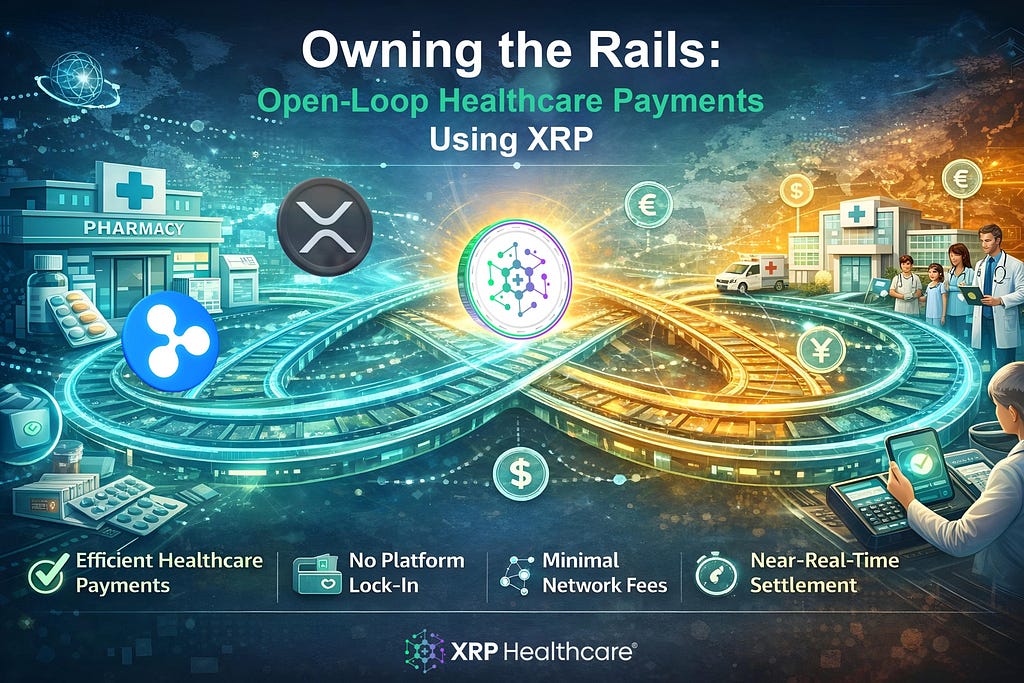
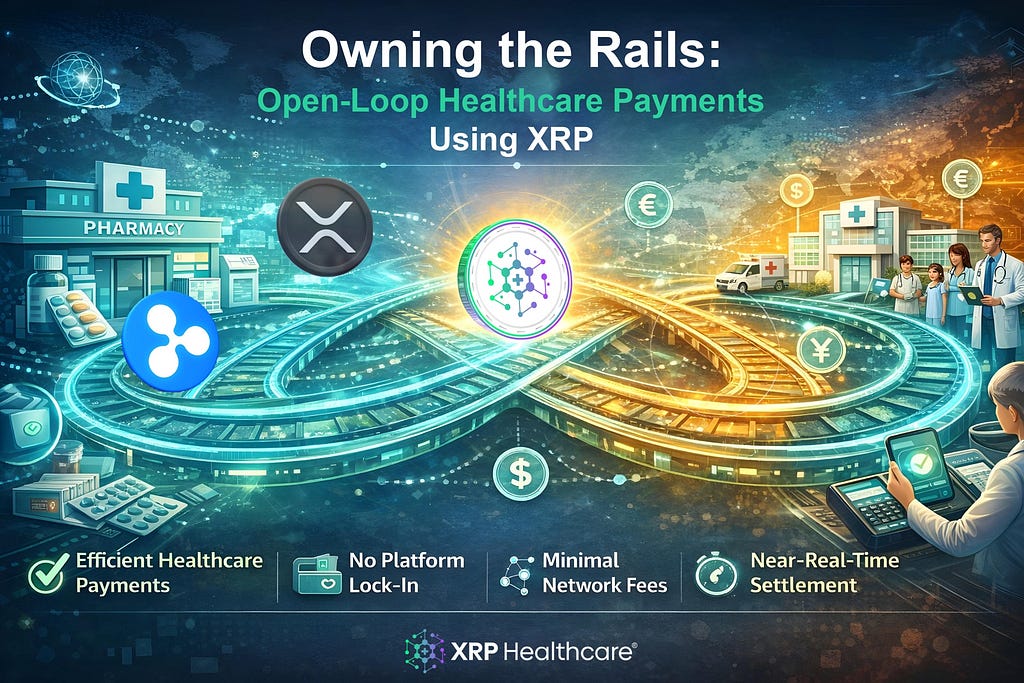
Healthcare payments should not be locked inside closed systems that fragment data, restrict participation, and limit interoperability.
Instead, the future of healthcare payment infrastructure lies in open-loop systems – frameworks that support choice, transparency, and seamless interaction across providers, payers, and platforms. Open-loop rails reduce friction, amplify reach, and empower the ecosystem to evolve without gatekeepers.
This blog explores how open standards powered by XRP can help build payment rails that are genuinely open, widely accessible, and capable of supporting next-generation healthcare infrastructure.
The Problem with Closed Payment Systems
Traditional payment models in healthcare often resemble tightly controlled loops. Each stakeholder – whether a payer, provider, or intermediary – operates within its own silo.
These closed systems suffer from:
• Fragmented data flows, making reconciliation difficult
• Limited interoperability, slowing down settlement speeds
• Vendor lock-in, reducing competition and innovation
• Complex integration overhead, discouraging new entrants
In healthcare, where payments must often flow across institutions, regions, and types of care, closed loops impose real costs on patients, providers, and the system as a whole.
Open-Loop Systems: A Better Foundation
An open-loop payment system is built on interoperability and shared standards. Rather than forcing participants into a single platform or vendor, open loops allow different actors to interact freely, exchange value, and build on common rails.
Key benefits of open loops include:
• Cross-system compatibility – providers and payers can transact without bespoke integrations
• Faster settlement – shared standards reduce reconciliation delays
• Greater transparency – consistent protocols improve auditability
• Competitive innovation – lower barriers encourage new solutions
In essence, open loops do not dictate the tools or platforms used by participants; they simply provide rails that all parties can trust and depend on.
Why Standards Matter in Healthcare Payments
Standards are the backbone of open systems. Without agreed-upon frameworks for messaging, settlement, and identity, interoperability is impossible.
In healthcare payments, standards ensure:
• Consistent interpretation of claims and settlements
• Clear identity of participants
• Protocols that reduce ambiguity and prevent fragmentation
Open standards prevent ecosystems from splintering into incompatible parts. They protect choice, reduce complexity, and allow the entire network of participants to build solutions that communicate seamlessly with one another.
Where XRP Fits In
XRP itself is not a closed system or a proprietary ecosystem. Instead, it serves as a settlement layer that can support open-loop frameworks.
What this means in practical terms is:
• XRP can serve as a common medium for clearing and settlement
• It operates independently of individual vendors or platforms
• It can interface with multiple systems using open standards
• It supports speed, reliability, and low-cost transfer of value
In an open-loop model, XRP does not lock participants into a proprietary stack. It provides a neutral settlement layer, enabling participants to transact across systems without requiring them to use a single vendor’s technology.
The Real Value of Open Rails
Open rails have real, measurable impact:
• Faster onboarding for new providers and payers
• Reduced integration costs for health systems
• Improved reconciliation workflows
• Lower administrative overhead for all stakeholders
Healthcare stakeholders – from clinics to national systems – benefit when payment rails are open, transparent, and interoperable.
Open Systems Encourage Innovation
When participants are not locked into proprietary networks:
• Startups can build on shared rails
• Existing systems can evolve without rewriting integration logic
• Collaboration becomes a practical advantage rather than a technical headache
Open rails, combined with open standards, create a foundation for innovation that is not limited by vendor control or single-supplier lock-in.
Bringing Open-Loop Payments to Life
Implementing open-loop healthcare payments is not an abstract concept. It requires:
• Adoption of interoperability standards
• A settlement layer that supports cross-system clearing
• Consistent identity and messaging protocols
• A governance framework that prioritizes openness and access
Open-loop models put the focus back where it belongs: on users, providers, and better outcomes – not on forcing everyone into a single closed platform.
Clarification on Corporate Structure
For clarity, here are the entities operating within the broader XRP Healthcare ecosystem:
• XRP Healthcare LLC operates all XRPH token, wallet, and blockchain-related activities.
• XRP Healthcare M&A Holding Inc. operates the XRPH AI App and healthcare platform initiatives and has no involvement in the XRPH token, digital assets, or wallet operations.
More information about the healthcare platform and AI initiatives is available at:
https://www.xrphealthcare.ai
A Future Built on Open Rails
Healthcare payments cannot continue to be constrained by closed loops and proprietary protocols. The next generation of payment systems must be open, accessible, and interoperable.
Open-loop rails – powered by shared standards and neutral settlement layers – provide the foundation for a healthcare ecosystem that is efficient, scalable, and innovation-friendly.
By focusing on openness, clarity, and connectivity, healthcare payments can finally meet the real-world needs of patients, providers, and innovators alike.
#Owning #Rails #OpenLoop #Healthcare #Payments #XRP
About the Author