In both technology and finance, there’s a fundamental truth that repeats itself over time:
infrastructure outlasts applications.
Apps evolve quickly. Interfaces change. Features are added, removed, or rebranded.
But the systems underneath – the payment rails – are what ultimately determine scale, reliability, and long-term relevance.
This distinction matters deeply as global payment systems evolve, particularly in complex sectors like healthcare.
Rails vs Apps: Understanding the Difference
Most conversations around payments focus on what users see:
• Apps
• Wallets
• Dashboards
• Interfaces
These are important – but they are implementations, not foundations.
Payment rails, by contrast, are the underlying systems that:
• Move value
• Guarantee settlement
• Enable interoperability
• Support compliance and trust
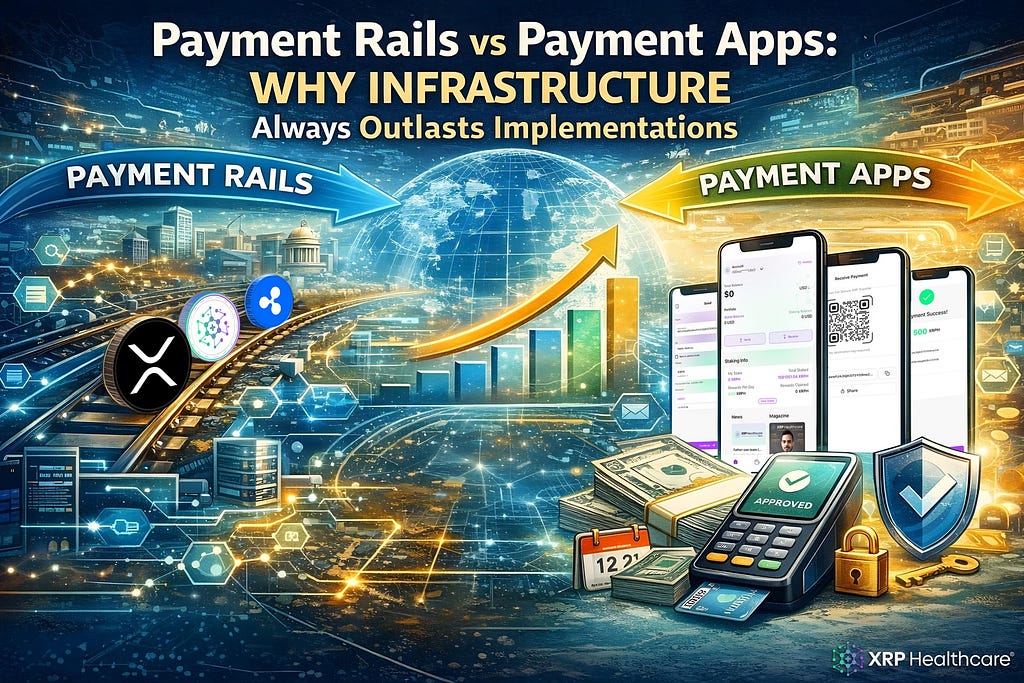
A simple way to think about it:
• Apps are the vehicles
• Rails are the roads
Vehicles can change endlessly. Roads are what allow movement at scale.
Why Infrastructure Always Wins Long Term
History makes this clear:
• Many payment apps emerge quickly
• Most are replaced, consolidated, or forgotten
• The systems that endure are those built on strong, reliable infrastructure
Apps improve user experience.
Infrastructure determines whether a system can survive real-world conditions.
Without robust rails, even the best-designed app eventually hits limits – fragmentation, friction, or trust breakdowns.
What Payment Rails Enable That Apps Cannot
For any serious payment system, especially in regulated and multi-party environments, infrastructure must deliver three things:
- Scale
The ability to handle growing transaction volumes without degradation.
2. Settlement Reliability
Confidence that value moves, clears, and settles consistently.
3. Interoperability
The ability for different systems, institutions, and participants to work together.
These are not app-level problems.
They are rail-level responsibilities.
Why This Matters in Healthcare Payments
Healthcare payments are among the most complex in the world. They involve:
• Patients
• Providers
• Pharmacies
• Insurers
• Regulators
• Cross-border flows
An app may simplify the surface experience, but only strong payment rails can support this complexity reliably.
Infrastructure-first design allows:
• Open systems instead of closed loops
• Reduced fragmentation between stakeholders
• Greater trust and transparency
• Long-term scalability
This is why infrastructure matters more than interfaces when building systems meant to last.
Infrastructure Is What Endures
Apps will continue to evolve.
User experiences will continue to improve.
But the systems that actually move value – the rails – are what persist.
Infrastructure outlasts implementations because it:
• Supports many applications simultaneously
• Enables innovation on top of it
• Can be upgraded without breaking ecosystems
• Anchors trust and reliability
Apps are replaceable.
Rails are foundational.
Important Clarification on Corporate Structure
To ensure clarity and avoid confusion, it is important to distinguish between separate legal entities operating within the broader ecosystem:
• XRP Healthcare LLC operates all XRPH token, wallet, and blockchain-related activities as a standalone legal entity.
• XRP Healthcare M&A Holding Inc. has no involvement in the XRPH token, digital assets, or wallet operations.
• For healthcare M&A and AI-focused activities, visit:
https://www.xrphealthcare.ai
This separation ensures proper governance, regulatory clarity, and alignment across distinct areas of activity.
Closing Thought
Interfaces attract users.
Apps improve experiences.
But infrastructure is what determines whether systems endure.
In payments – and especially in healthcare – rails matter more than implementations.
They are the quiet foundations that allow innovation to scale, trust to form, and real-world systems to last.
#Payment #Rails #Payment #Apps #Infrastructure #Outlasts #Implementations
About the Author