Healthcare payments operate in one of the most complex environments in the world. They involve patients, providers, pharmacies, insurers, regulators, and technology platforms – often across borders and jurisdictions.
In systems this complex, technology alone is not enough.
For healthcare payment infrastructure to work at scale, clarity of identity is just as important as speed, security, and interoperability. This is where trademark ownership becomes foundational infrastructure, not a legal afterthought.
Infrastructure Requires More Than Code
Payment systems that support healthcare must be trusted, predictable, and interoperable. They need to integrate across multiple parties while handling sensitive financial and operational data.
But without clear ownership of the underlying infrastructure identity, even technically sound systems can struggle to gain adoption.
Clear trademarks provide:
• A single, recognised infrastructure identity
• Protection against misrepresentation and confusion
• Confidence for partners integrating at scale
• Consistency across platforms and jurisdictions
In healthcare, trust is not optional. It is structural.
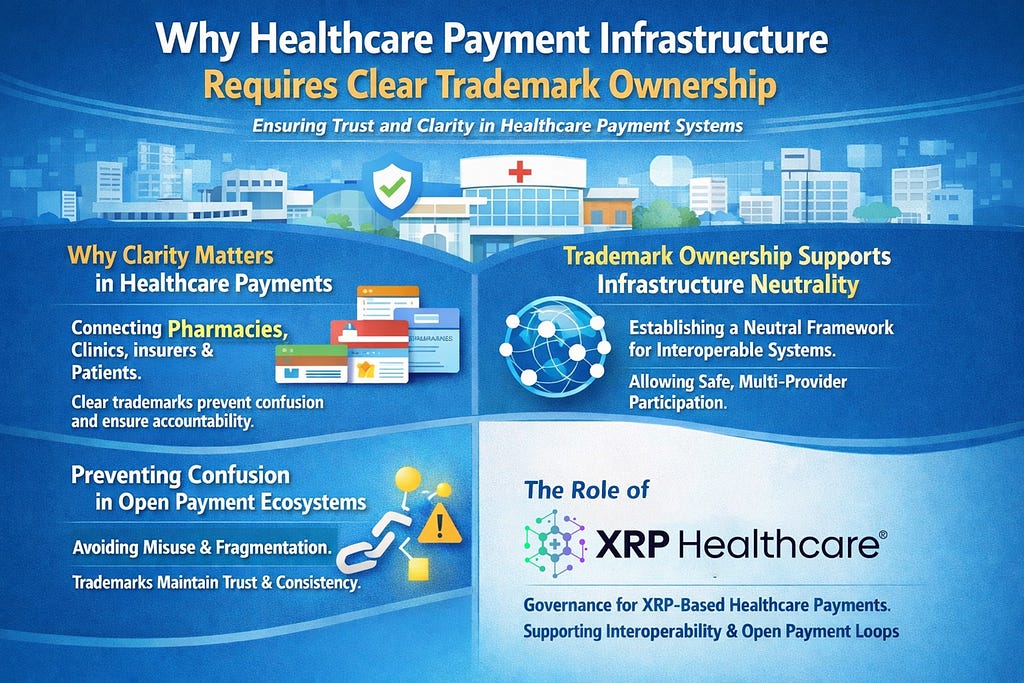
Why Trademark Clarity Matters in Healthcare Payments
When multiple entities operate within the same ecosystem – wallets, rails, platforms, service providers – unclear branding can lead to serious issues:
• Users unsure which system they are interacting with
• Partners hesitant to integrate due to ambiguity
• Fragmentation of standards and expectations
• Increased risk of misuse or imitation
Trademark ownership helps anchor an ecosystem to a clear, recognised source. This clarity reduces friction and strengthens trust across all participants.
Avoiding Confusion in Open Payment Ecosystems
Healthcare payment infrastructure is increasingly moving toward open, interoperable models. While openness enables scale, it also increases the importance of identity clarity.
Without clear trademark ownership:
• Open systems risk being misunderstood or misused
• Ecosystem participants may operate under false assumptions
• Long-term trust can erode
Clear trademarks ensure that openness does not come at the cost of reliability or accountability.
Trademarks as Infrastructure, Not Marketing
In healthcare payments, trademarks are not just branding tools – they function as part of the infrastructure layer.
They:
• Signal legitimacy to institutional partners
• Support interoperability agreements
• Provide consistency across technical integrations
• Help regulators, partners, and users understand who is responsible for what
This identity layer complements the technical rails by making systems recognisable and dependable.
Supporting Adoption and Long-Term Scale
Healthcare payment systems succeed when they are:
• Easy to understand
• Clearly governed
• Trusted across stakeholders
• Built for longevity
Trademark clarity plays a critical role in all of these. It reduces ambiguity and supports the confidence required for real-world adoption.
As healthcare payments expand across regions and use cases, clarity becomes an enabler of scale rather than a constraint.
Entity Clarification
XRP Healthcare M&A Holding Inc. is a Dubai-based healthcare acquisition and technology company, focused on AI-powered healthcare initiatives and pharmacy M&A across Africa. This entity is legally and operationally separate from XRP Healthcare LLC, which manages all XRPH token and digital asset activities. XRP Healthcare M&A Holding Inc. does not issue, control, or benefit from the XRPH token. For digital asset information, visit www.xrphtoken.com.
Final Thought
Healthcare payment infrastructure cannot rely on technology alone.
It requires clarity, accountability, and trust.
Clear trademark ownership provides the identity foundation that allows open, interoperable payment systems to function reliably – especially in healthcare, where confidence and precision matter.
Infrastructure that lasts is built on more than rails.
It is built on clarity.
#Healthcare #Payment #Infrastructure #Requires #Clear #Trademark #Ownership
About the Author