Payments in healthcare are evolving — but not always fast enough to keep up with the needs of modern systems. From patient billing to pharmacy reimbursements and supplier settlements, legacy financial rails remain slow, costly, and fragmented.
Across billions of interactions every year, inefficiencies in settlement, interoperability, and cost continue to constrain providers and payers alike. To meet the demands of modern medical payments, infrastructure must evolve.
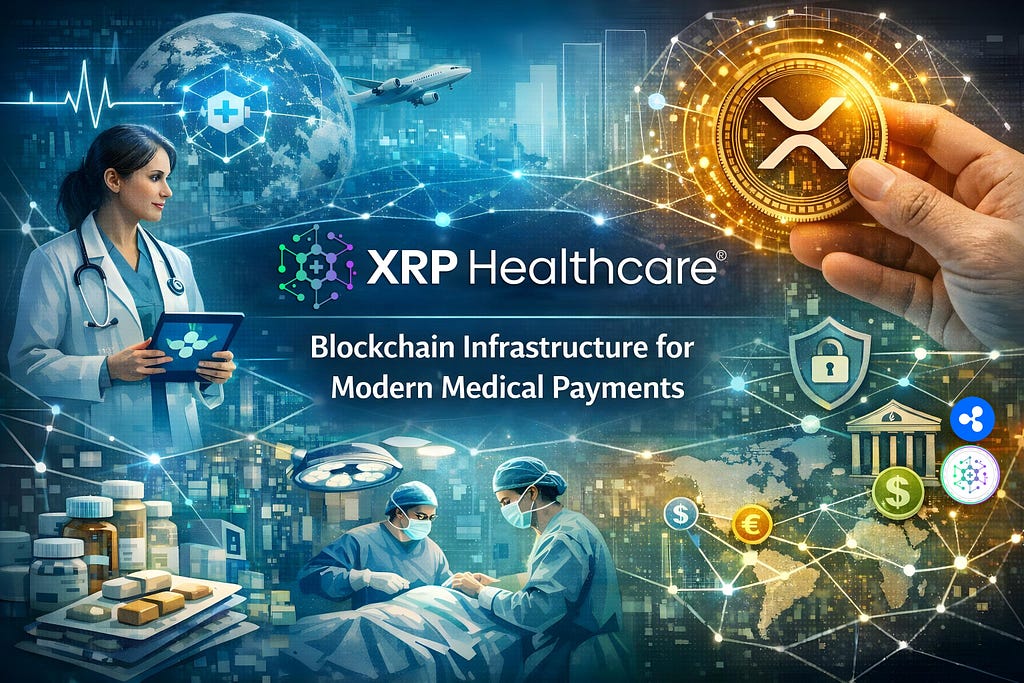
Blockchain settlement infrastructure, particularly through XRP Ledger (XRPL), presents a new paradigm: open, efficient, and real-time value transfer designed to meet healthcare’s unique challenges.
The Healthcare Payments Challenge
Traditional healthcare payment channels were not built for speed or flexibility. Many systems still rely on legacy networks that:
- Incur high transaction costs
- Require multiple intermediaries
- Settle slowly
- Operate within closed, siloed frameworks
The consequences:
• Delayed reimbursements
• Cash flow constraints
• Administrative burden
• Fragmentation across providers and networks
These limitations don’t just inconvenience administrators — they have real impact on care delivery.
Why Infrastructure Matters
Before healthcare can become faster, more efficient, and more accessible, its financial infrastructure must be capable of scaling with demand.
Infrastructure is not about applications alone — it’s about the rails that connect them.
Open, interoperable rails enable:
✔ Near-real-time settlement
✔ Predictable costs
✔ Cross-platform interaction
✔ Reduced dependency on legacy intermediaries
This shift offers the promise of payments that are faster, cheaper, and more transparent — aligning financial flows closer to the pace of care delivery.
Enter the XRP Ledger (XRPL)
The XRP Ledger was designed from the ground up as a high-performance settlement layer. It offers:
- Fast transaction finality — settlement in seconds
- Low and predictable transaction costs
- Open standards and interoperability
- Scalability for high-volume use cases
These traits make XRPL well-suited for mission-critical environments such as medical payments, where speed, reliability, and cost matter.
Rather than displacing existing payment systems, XRPL can augment them by providing a settlement backbone that is transparent, efficient, and adaptable.
How Blockchain Infrastructure Enhances Medical Payments
Healthcare payment flows span a range of interactions:
1. Patient Payments
Patients expect convenience and clarity at the point of care. Slow settlement delays refunds and support.
2. Provider Reimbursements
Insurance payouts and institutional transfers often lag, creating strain on operational cash flow.
3. Pharmacy Settlements
Pharmacy networks, especially large chains, require settlement partners that can match their operational tempo.
Through blockchain infrastructure, these flows become:
✔ Faster
✔ More predictable
✔ Less reliant on intermediaries
By embedding settlement into the financial layer, friction decreases and value moves more swiftly between parties.
XRPH Wallet: Practical Interface for Settlement
For blockchain settlement to be useful, it must be accessible. That’s where the XRPH Wallet comes in — providing a non-custodial means of interacting with open rails built on XRPL.
The XRPH Wallet allows value transfer within healthcare payment workflows without locking participants into custodial or closed systems. It enables:
• Direct settlement between participants
• Minimal settlement costs
• High-speed transfers
This infrastructure-first approach distinguishes settlement at the layer beneath applications, allowing developers, clinics, pharmacies, and systems to build on top of robust rails.
Blockchain Isn’t Just a Buzzword — It’s Infrastructure
While many industries talk about blockchain in abstract terms, healthcare payments require real utility.
Blockchain infrastructure for medical payments:
✔ Reduces dependency on legacy intermediaries
✔ Increases transparency
✔ Enables real-time settlement
✔ Supports interoperability across providers
These outcomes shift healthcare payments from slow, costly networks to efficient, scalable systems.
Separation of Entities — Important Clarification
XRP Healthcare LLC operates all XRPH token, wallet, and blockchain activity as a standalone legal entity.
XRP Healthcare M&A Holding Inc. has no involvement in the XRPH token, digital assets, or wallet operations.
This distinction helps ensure clarity between:
• Token / settlement infrastructure activity (managed by XRP Healthcare LLC), and
• Healthcare M&A and AI-related initiatives (managed through xrphealthcare.ai by the holding company).
For broader healthcare acquisition strategy and AI initiatives, visit:
www.xrphealthcare.ai
Final Perspective
Healthcare will always be driven by human needs — urgency, timeliness, access, and trust. But the financial systems that support care delivery need not be limited by legacy constraints.
Blockchain settlement infrastructure — particularly through the XRPL and real-world interfaces like the XRPH Wallet — provides a foundation capable of modernising medical payments.
Infrastructure comes first. Applications come next. When value flows efficiently at the base layer, the entire healthcare ecosystem becomes more capable, resilient, and scalable.
#XRP #Healthcare #Blockchain #Infrastructure #Modern #Medical #Payments
About the Author