Healthcare AI is not built in a vacuum. No matter how advanced the technology, it will only succeed if it truly reflects the needs and realities of the people it serves.
Too often, AI products are designed around assumptions – what developers think users want – rather than what users actually need. This gap leads to features that look impressive on paper but fail in real-world healthcare settings.
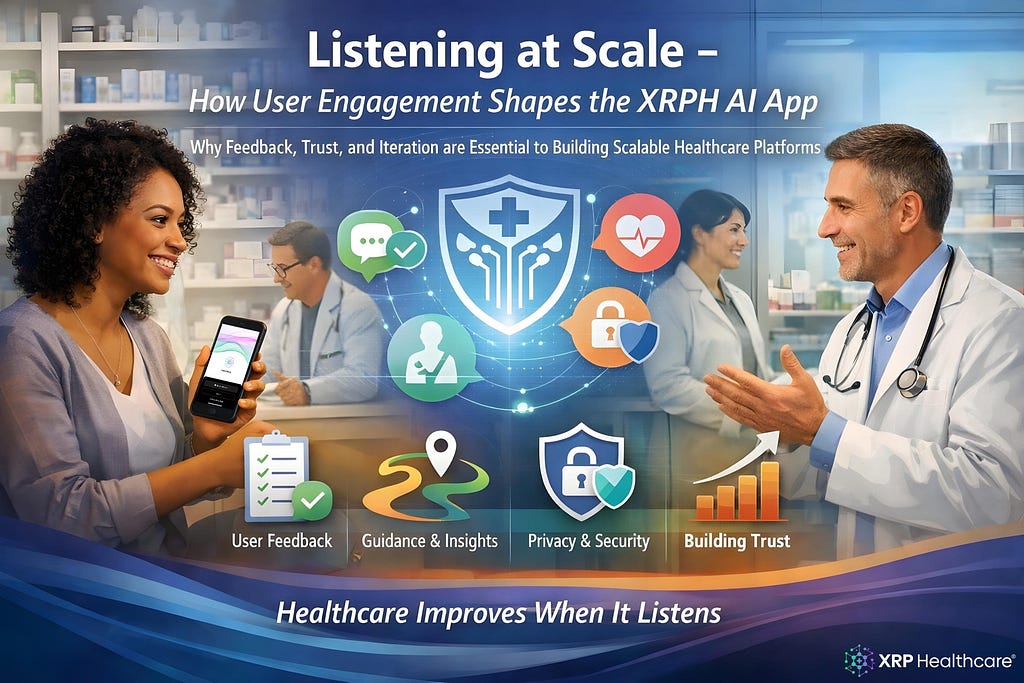
At XRPH AI, our approach is different. We believe that user engagement isn’t an afterthought – it’s the foundation of product evolution. Listening at scale isn’t a slogan – it’s how we decide what to build next.
Why Listening Matters in Healthcare AI
Healthcare is one of the most human-centered industries. When AI is introduced into this landscape, the technology must adapt not only to clinical workflows and data systems, but to diverse human needs:
• Variations in language and cultural context
• Differences in health literacy and access
• Local practices and regulatory environments
• Unique patient experiences and expectations
Without real user feedback, AI risks becoming a solution in search of a problem.
This is why listening – at scale – changes the trajectory of the technology from theoretical to practical, and from experimental to essential.
Building the XRPH AI App Around Real People
At the heart of the XRPH AI App is a simple but powerful idea: users should shape the evolution of the product – not the other way around.
We capture engagement through direct feedback loops, analytics, and contextual usage data. This includes both qualitative signals (user comments, reported pain points) and quantitative trends (feature usage patterns, retention rates).
By structuring product development around real engagement signals, XRPH AI avoids two common pitfalls:
• Building features no one uses
• Guessing what users want instead of knowing
Listening at scale ensures that every iteration is informed, valuable, and grounded in reality.
How User Engagement Improves Healthcare AI
When user engagement informs design, several outcomes emerge:
1. Better Prioritization
Instead of guessing which features matter, we let actual usage guide us. This ensures development resources are spent on what delivers genuine value
2. Increased Adoption
Users adopt tools they understand and see immediate value in. Engagement metrics help us identify friction points and improve usability.
3. Contextual Relevance
Healthcare is not uniform. What works in one setting may not in another. Engagement feedback reveals regional dynamics and informs customization.
4. Continuous Learning
AI thrives on data. Real user interactions become part of the model’s learning pathway, refining performance over time.
Listening at Scale: What It Looks Like in Practice
Listening at scale is more than surveys or feedback buttons. It’s a continuous cycle:
1. Observe real usage behavior
2. Collect and categorize feedback
3. Identify patterns and unmet needs
4. Prioritize meaningful improvements
5. Deploy changes
6. Observe again
This loop creates a product that evolves with its users – not independently of them.
In practical terms, this means:
• Data-driven decisions over intuition
• Iterative improvements instead of sporadic updates
• Human-centered design over feature-first thinking
Why This Matters for Digital Healthcare
Healthcare users are diverse:
• Patients with different abilities and histories
• Clinicians under operational pressure
• Administrators balancing efficiency and compliance
• Caregivers with unique emotional needs
For AI to be truly helpful, it must be context-aware and user-informed.
Listening at scale doesn’t just improve the XRPH AI App – it aligns the technology with the real challenges healthcare professionals and patients face every day.
The Promise of Engagement-Driven Development
Product teams often talk about “agile” and “user-centered design,” but few execute it at meaningful scale. At XRPH AI, engagement data isn’t just a reference – it’s the basis of evolution.
This approach results in:
• More usable interfaces
• Faster adoption curves
• Better accuracy in AI responses
• Higher trust among users
• A product that feels built with users, not for them
AI that listens evolves into AI that truly helps.
Looking Ahead
Healthcare AI is still in its early stages, but the winners won’t be determined by flashy features or theoretical capabilities. They will be determined by relevance, usability, and responsiveness.
By listening at scale, XRPH AI is building a solution that adapts where it matters most – in real healthcare environments, with real users and real needs.
This is how AI becomes a tool that works for people, not around them.
Final Thought
In healthcare, assumptions can be dangerous. But listening, especially at scale, leads to understanding – and understanding is what makes AI truly useful, trusted, and transformative.
The future of healthcare AI isn’t built in isolation – it’s built with engagement, feedback, and real-world experience.
Learn More
To explore the XRPH AI App and our broader healthcare strategy, visit:
www.xrphealthcare.ai
#Listening #Scale #User #Engagement #Shapes #XRPH #App
About the Author