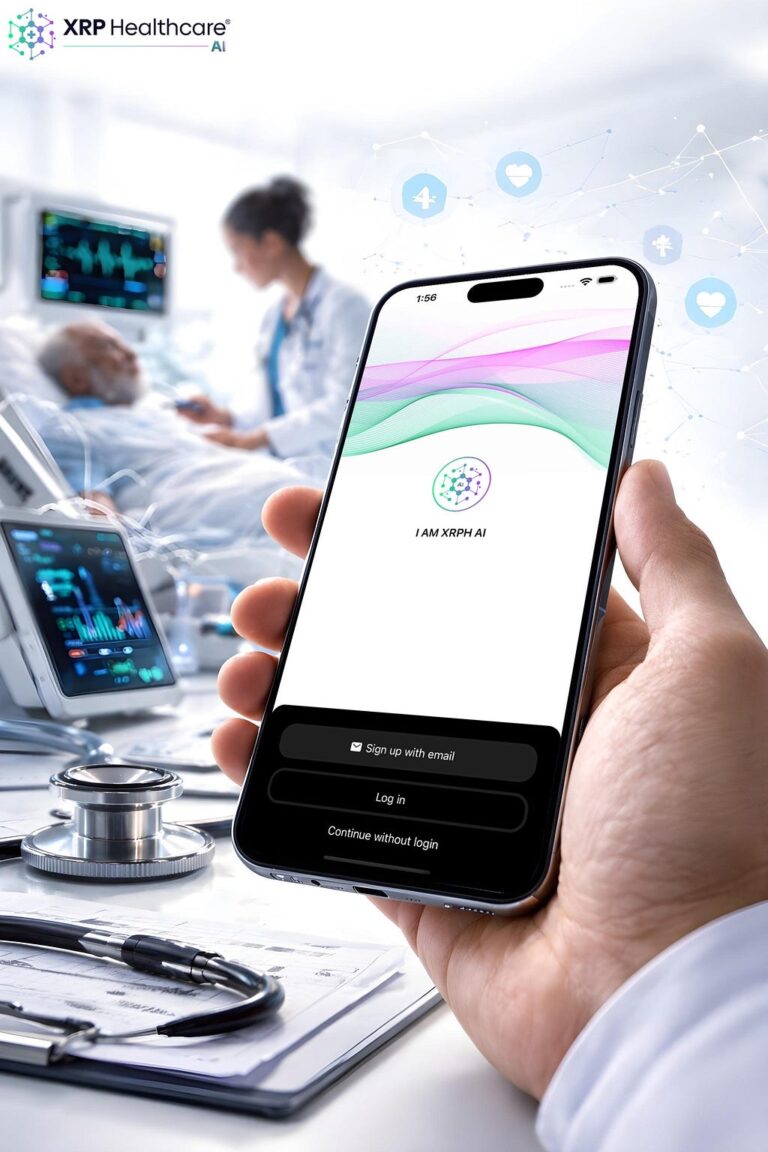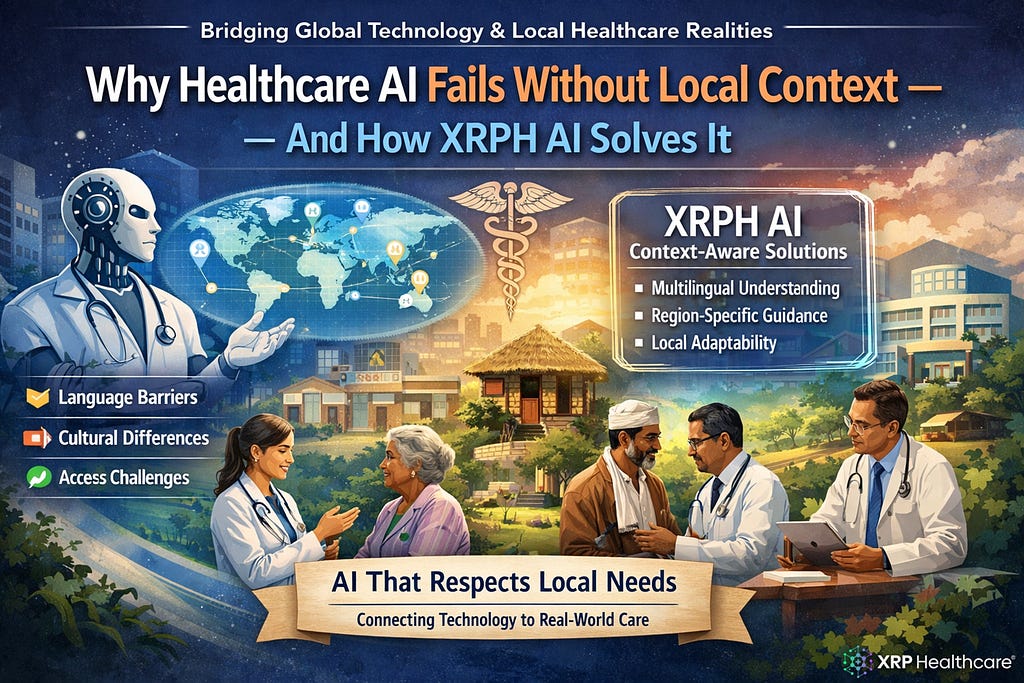
Artificial intelligence promises big things for healthcare – faster insights, personalised guidance, predictive tools, and automated support. But in practice, many healthcare AI solutions fall short of expectations. The reason isn’t the technology itself – it’s that adoption depends far more on context than code.
Healthcare AI only works when it understands the people it’s built to serve.
Too often, AI products are developed without sufficient regard for local language, cultural norms, real-world infrastructure, and the diverse needs of patients and providers. When those elements are ignored, even the most advanced algorithms struggle to deliver meaningful outcomes.
XRPH AI takes a different approach – one grounded in understanding real human context, not just technical capability.
Why Local Context Matters
Healthcare is not a uniform experience. What works in one region, language group, or care setting may not work in another. Context affects everything from how health information is communicated to how care decisions are made.
Consider:
• Language nuance and dialect
• Cultural norms around care and communication
• Varying levels of digital access
• Differences in healthcare delivery models
AI that fails to account for these realities will struggle to resonate with users – and ultimately, struggle to deliver value.
Language Is Not Just Code – It’s Meaning
One of the most visible manifestations of context is language. AI trained primarily on major global languages can miss idiomatic usage, local phrasing, or culturally specific concepts essential for understanding health queries.
When patients or providers use language that slips outside rigid models, misunderstanding can occur – sometimes with serious consequences. Addressing this requires AI that:
• Handles dialect variation
• Pays attention to subtle phrasing differences
• Adapts responses to cultural meaning
XRPH AI is designed with these considerations in mind, helping ensure that communication is not only accurate but relevant to users’ lived experiences.
Culture Shapes Healthcare Decisions
Beyond language, cultural context influences how people think about symptoms, treatment preferences, trust, and even healthcare engagement behaviour.
AI systems that ignore cultural context may provide guidance that feels irrelevant, inappropriate, or alien to the people who need it most. Building AI that resonates requires understanding how people in different communities approach health and wellness.
This is a core principle informing the development of XRPH AI: alignment with the users’ reality, not assumptions about it.
Infrastructure and Accessibility
Context isn’t just linguistic or cultural – it’s also about infrastructure.
Healthcare users don’t all have access to high-speed connectivity, the latest devices, or stable internet. Many regions operate with intermittent access, limited bandwidth, or older technology.
AI solutions built for ideal conditions fail when used in real, everyday environments. A context-aware healthcare AI must be resilient, accessible, and flexible across a range of technical constraints.
XRPH AI incorporates these design principles, ensuring that connectivity limitations don’t become barriers to utility.
Designing AI for Human Experience
Historical AI development often centres on datasets, algorithms, and computational performance. That’s necessary – but not sufficient for healthcare.
A human-centred approach recognises that:
• AI must adapt to the people who use it
• Technology must reflect diverse user environments
• Practical utility matters more than theoretical capability
This is where systems like XRPH AI differentiate themselves: by design, not by novelty.
For more on how XRPH AI is addressing real-world user needs across diverse healthcare contexts, visit: www.xrphealthcare.ai.
Real-World Impact Over Theoretical Capability
When local context is central to how an AI solution is built, the outcomes change:
• Users feel understood
• Engagement increases
• Adoption becomes sustainable
• Healthcare decisions become more informed
• Trust in AI-guided interaction improves
Aligning healthcare AI with the realities of human experience isn’t an optional add-on – it’s a requirement for systems meant to improve outcomes and support users in meaningful ways.
Final Thought
Artificial intelligence holds tremendous promise for healthcare. But without grounding in local context – language, culture, infrastructure, and lived experience – that promise remains aspirational rather than real.
AI that listens, adapts, and respects context becomes not just a tool, but a trusted support. That’s the future XRPH AI is working toward – one where healthcare AI works for people, not around them.
Learn More
For additional insights into how XRPH AI is being developed with real-world context and user engagement at its core, visit:
www.xrphealthcare.ai
#Healthcare #Fails #Local #Context #XRPH #Solves
About the Author